

Key Takeaways
- You can get pregnant with PCOS and irregular periods. PCOS can make conception slower, but not impossible. The key is identifying your fertile window.
- Ovulation kits, temperature tracking, and follicle monitoring ultrasound can help track ovulation, though ultrasound is often most accurate in PCOS.
- Many women with PCOS conceive naturally, while others may need ovulation support such as letrozole or other treatments.
- A low glycaemic index diet, regular exercise, better sleep, and stress management can improve hormones and support fertility.
- IVF is an option when simpler treatments are not successful.
- If you have been trying for 6 months with irregular cycles, or your periods are absent, see a fertility specialist early for the best options.
I hear this most often from women with PCOS. “Doctor, will I be able to have children?”
Your periods arrive whenever they choose, or not at all. You tracked your cycle, read every article, searched every forum at midnight. And none of it helps.
What you want to know is whether you can still get pregnant when you already have PCOS. The answer is yes. You can get pregnant with PCOS by identifying ovulation, improving hormonal balance, and using the right fertility support when needed.
PCOS and irregular periods make pregnancy more complicated. They do not make it impossible. Understanding your body is the first real step. And that is exactly what this blog is here to help you do.
Let me show you what the path looks like.
What PCOS Does to Fertility
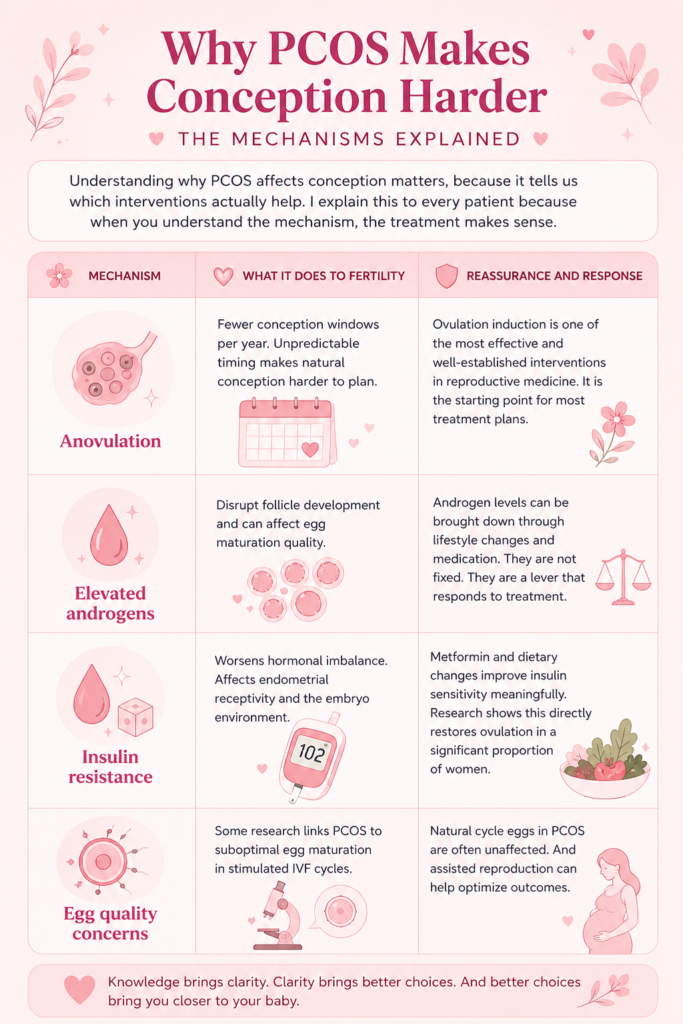
PCOS does not cause infertility. It is the most common cause of anovulatory subfertility, which is a very different thing. Subfertility means conception may take longer or need support. It does not mean conception is not possible.
How long does it take to get pregnant with PCOS?
According to a large prospective cohort study published in Human Reproduction Open, the follow-up of 1,779 women with PCOS found the following live birth rates:
- 1 Year: 37% of women achieved a pregnancy leading to a term live birth.
- 2 Years: 50% achieved a pregnancy leading to a term live birth.
| What PCOS affects | How it affects fertility | What it does NOT mean |
|---|---|---|
| Ovulation frequency | Irregular or absent ovulation means fewer conception windows each year | You never ovulate. Most women with PCOS do ovulate, just unpredictably |
| Hormonal environment | Elevated LH, insulin resistance, and androgens affect egg development and implantation | Your eggs are damaged beyond use. Egg quality varies and is addressable |
| Cycle predictability | Irregular periods make it harder to time intercourse or treatment accurately | Conception is impossible. It means timing needs more support |
| Metabolic health | Insulin resistance can worsen hormonal imbalance and affect the embryo environment | Pregnancy is unsafe. Most PCOS pregnancies are managed successfully |
PCOS is also associated with a higher rate of anovulatory infertility across all women seeking fertility support. But anovulatory infertility is one of the most treatable forms of subfertility in reproductive medicine. The distinction between infertility and subfertility matters enormously, and I want you to hold onto it.
A clinical note on the PCOS infertility rate:
Studies estimate that approximately 70 to 80% of women with anovulatory infertility have PCOS. This sounds alarming until you understand what it also means: that we know exactly what is causing the problem, and that we have effective treatments for it. A known cause is a solvable problem.
Also read: How to Know If You Have PCOS or PCOD: Symptoms, Signs & Diagnosis
How to Get Pregnant With PCOS: The Full Approach
Track 1: Lifestyle — Levers, Not Punishments
When I talk to my patients about lifestyle, I am not asking them to become someone else. I am explaining which specific changes have a direct effect on the hormonal environment that is making ovulation irregular. These are small, targeted changes, not a complete overhaul of your life.
| What to do | Why it works | How to follow |
|---|---|---|
| Low-GI diet | Lower insulin reduces androgen production. Lower androgens support more regular ovulation. | Eat in a way that keeps your blood sugar stable throughout the day. Whole grains, legumes, vegetables, protein. Less processed food, less refined sugar. |
| Consistent movement | Improves insulin sensitivity. Resistance training shows particularly strong effects. | A walk every day is worth more than an intense workout once a week, followed by guilt about stopping. |
| Sleep | Hormones reset at night. Poor sleep raises cortisol, which suppresses the LH surge needed to trigger ovulation. | Seven to eight hours of consistent sleep directly supports the hormonal axis. |
| Stress reduction | Cortisol competes with progesterone and suppresses the LH surge. Chronic stress directly delays or prevents ovulation. | Stress-reduction interventions have been shown to help restore and improve pregnancy rates. |
Track 2: Medical Support — Your Doctor May Recommend…
Every option below depends on the individual clinical profile. I am explaining what each treatment does and when it is considered, not prescribing for anyone reading this. The right choice for you will be determined by a doctor who has assessed your specific situation.
| Treatment | What it does |
|---|---|
| Letrozole (aromatase inhibitor) | Blocks oestrogen production briefly, which triggers FSH release and stimulates follicle development. Now first-line for ovulation induction in PCOS. |
| Clomiphene citrate | Older first-line ovulation induction agent. Still effective for many patients. Carries a slightly higher rate of multiple pregnancy than letrozole. |
| Metformin | Insulin sensitiser. Reduces androgen production indirectly by improving how cells respond to insulin. May restore ovulation over several months. |
| Ovarian drilling (laparoscopic) | A surgical procedure where small punctures are made in the ovary to reduce androgen-producing tissue and trigger ovulation. |
| IUI (intrauterine insemination) | Sperm is placed directly into the uterus at the time of ovulation, usually after ovulation induction with medication. |
| IVF (in vitro fertilisation) | Eggs are retrieved, fertilised in a laboratory, and the resulting embryo is transferred to the uterus. |
| Mental health support | Therapy, counselling, or structured support for anxiety, depression, and the emotional weight of fertility challenges. |
What Irregular Periods Actually Mean for Conception
This is the section I find myself explaining the most in consultations. Because the confusion around periods and ovulation is genuine, and it has real consequences for how women approach trying to conceive.
I Have Periods. But Am I Actually Ovulating?
Having a period does not confirm ovulation. This is one of the most important things I tell my patients with PCOS, and it surprises almost all of them.
A period can occur without a preceding ovulation. This is called an anovulatory cycle. In PCOS, anovulatory cycles are common. An anovulatory cycle, however much it looks like a normal period, leaves no egg available for fertilisation.
How to identify ovulation signs even with an irregular cycle:
- Basal body temperature (BBT): Your resting temperature rises slightly after ovulation. A consistent rise over several days suggests ovulation has occurred. With PCOS, patterns are harder to read, but tracking over time can reveal a picture.
- Cervical mucus changes: In the days leading up to ovulation, mucus becomes clear and stretchy, similar to raw egg white. This is one of the more reliable signs, even in irregular cycles.
- LH surge kits (ovulation predictor kits): These detect the LH hormone surge that precedes ovulation by 24 to 36 hours. They work for many women with PCOS, but there is an important caveat below.
- Mild pelvic discomfort: Some women feel a dull ache or cramping on one side near ovulation. This is called mittelschmerz. It is not universal, but where it is present, it can be a useful signal.
Clinical note: In women with PCOS, LH levels may be chronically elevated. This means ovulation predictor kit strips can read positive throughout the cycle rather than only at actual ovulation. If you are using OPK strips and getting frequent or continuous positive readings, that result is likely not reliable. Ultrasound monitoring with a gynaecologist is often the most accurate way to confirm ovulation timing.
I hear from many of my patients that they have tried multiple apps, two or three different OPK brands, and basal temperature charts, and still feel completely in the dark about when, or whether, they are ovulating. And that is exactly why clinical monitoring exists.
When Should I Try to Conceive if My Cycle Has No Pattern?
This is the practical question that follows once a woman understands the ovulation problem. If her cycle is unpredictable, how does she identify the right time?
Ways to help identify your fertile window
- OPK kits with awareness of the PCOS caveat: Use them as a rough guide. If you see a sustained positive across many days, consider moving to ultrasound monitoring instead.
- Follicle monitoring ultrasound: A scan from around Day 10 of the cycle tracks follicle growth and confirms when ovulation is approaching or has occurred. For women with PCOS, this removes the guesswork entirely.
- BBT charting over 2 to 3 months: Even with irregular cycles, a pattern may emerge over time. It is not precise enough to act on alone, but it adds useful context.
On sex position and conception frequency
- Sex position to conceive with PCOS: There is no clinical evidence that any specific position significantly improves conception chances. This is one of the most searched topics in fertility, and the honest answer is that position matters far less than timing.
- What does matter: Having regular intercourse throughout the estimated fertile window, which with PCOS may be identified through OPK or ultrasound monitoring.
- Frequency: Every one to two days during the suspected fertile window is the evidence-backed recommendation.
The Part No Fertility Article Prepares You For
I want to talk about something that does not appear in most clinical resources. The psychological weight of trying to conceive with PCOS and irregular periods is its own medical concern. And I mean that literally.
Seeing a pregnancy announcement in a WhatsApp group, or at a family gathering, or on social media, while you are quietly tracking a blank chart, causes a very specific kind of grief. I hear about it from my patients regularly. It is not a weakness. It is a normal response to a genuinely difficult situation.
In India specifically, the cultural pressure compounds this. There are family members who ask questions without understanding the complexity. There are in-laws who assume a delay in pregnancy reflects a problem with the woman. There are husbands who do not always know how to be present in this. The emotional weight is layered.
Clinical note: Research consistently links chronic psychological stress to worsened PCOS symptoms, not through attitude but through direct hormonal pathways. Elevated cortisol suppresses LH production and can delay or disrupt ovulation. Addressing mental health is not optional in fertility care. It is part of the treatment itself.
The stress is not in your head. It is in your body. And it deserves to be taken seriously in your treatment plan.
Dr. Tejinder Kaur offers personalised fertility consultations for women with PCOS and PCOD in Tricity.
Every consultation begins with a full hormonal assessment and a conversation about your specific situation, not a generic recommendation.
Book a Fertility Consultation with Dr. Tejinder Kaur
The Age Factor
Fertility in PCOS, as with all women, is influenced by age. Under 35, the chances with support are genuinely good. After 35, ovarian reserve decreases more rapidly, and the timeline shortens.
I say this not to create pressure, but to make a case for seeking evaluation early rather than waiting. If you are in your late twenties or early thirties and you know you have PCOS, a fertility review now gives you more options later.
Myths About PCOS and Pregnancy That Are Causing Real Harm
| What women are told (myth) | What is actually true |
|---|---|
| You need to lose weight before trying | Conception is possible at any weight. Modest weight change can help regulate ovulation but it is not a prerequisite. Linking conception access to weight loss causes real harm. |
| PCOS means you are infertile | PCOS is the leading cause of anovulatory subfertility, not infertility. Most women with PCOS can conceive, with medical support. |
| If your periods are regular, you do not have a fertility problem | PCOS can coexist with regular-looking cycles. Hormonal imbalance does not always stop ovulation visibly. |
| Stress is all in your head. Just relax, and it will happen. | Chronic psychological stress directly elevates cortisol, which suppresses LH and can delay ovulation. This is physiology, not attitude. |
| After 6 months of trying, IVF is the only option | Many women with PCOS respond well to oral ovulation induction before IVF is considered. IVF is not the only path. |
| Supplements like inositol will fix your PCOS fertility | Myo-inositol shows promising evidence for improving insulin sensitivity and ovulation frequency. It is supportive, not a cure, and not a substitute for medical evaluation. |
What Happens During Pregnancy With PCOS
Reaching a pregnancy with PCOS is not the end of the conversation. I want to give you honest, reassuring information about what to expect once you are pregnant, because the concerns do not disappear at conception.
| Topic | What to know |
|---|---|
| Early pregnancy symptoms with PCOS | Early symptoms such as bloating, fatigue, and breast tenderness can overlap with PCOS symptoms. This can make early detection feel confusing. A home pregnancy test is accurate regardless of PCOS. Use it as soon as a period is late or missed. |
| How to detect pregnancy with PCOS | Standard home pregnancy tests work the same way for women with PCOS as for anyone else. If a home test is uncertain and symptoms persist, a blood beta-hCG test is more sensitive and can confirm very early pregnancy. |
| Elevated pregnancy risks | Women with PCOS have higher rates of gestational diabetes, pregnancy-induced hypertension, pre-eclampsia, and preterm birth. A 2026 Indian study found a 17% higher risk of preterm delivery in PCOS patients. |
| PCOS after childbirth | PCOS does not resolve after delivery in most women. Symptoms may shift or temporarily reduce during breastfeeding due to hormonal changes, but the underlying condition persists. |
| Babies born to PCOS mothers | Research shows a slightly elevated risk of metabolic conditions in offspring of mothers with PCOS. Healthy outcomes are the norm. The risks noted in research are monitoring signals, not reasons for avoidance. |
A Final Word
The truth is this. PCOS makes the path to pregnancy longer and sometimes harder. It does not close that path.
Before you leave this page:
- If you have been trying for 6 months with PCOS and irregular cycles: see a specialist. Now.
- If the emotional weight is affecting you, say that out loud in your next appointment. Mental health is part of this treatment, not a separate concern.
- If you are just beginning, start with a hormonal assessment, a follicle tracking ultrasound, and an honest conversation. That is the right first step.
If you have been silently carrying the stress of PCOS and delayed pregnancy, this is your sign to stop carrying it alone.
Dr. Tejinder Kaur’s clinic offers personalised fertility assessments with clear answers and compassionate guidance.
Book an appointment today.Frequently Asked Questions
Q1: Can I get pregnant naturally with PCOS and irregular periods?
Yes. Irregular periods usually mean irregular ovulation, not absent fertility. The focus is to identify and support ovulation instead of waiting for cycles to regulate on their own. Many women with PCOS conceive naturally.
Q2: Does PCOS mean poor egg quality?
No. PCOS affects the hormones around egg development, not the eggs themselves. Egg quality can sometimes be affected in IVF cycles, especially with insulin resistance or high androgen levels. In natural cycles, egg quality is often normal or close to normal.
Q3: Can you get pregnant with PCOS and irregular periods?
Yes, directly and clearly. Irregular periods in PCOS mean unpredictable ovulation, not the absence of all fertility. Ovulation predictor kits, basal body temperature tracking, and ultrasound follicle monitoring are all tools that help with this.
Q4: What is the best treatment to get pregnant with PCOS?
There is no single best treatment because the right choice depends on the individual clinical picture. For most women with PCOS who need ovulation support, letrozole is currently the first-line recommendation based on the strongest evidence. Lifestyle support is a concurrent intervention for almost all patients. IVF is an excellent option when earlier approaches are insufficient.
Q5: How do I know if I am ovulating with PCOS?
Useful tools include temperature tracking, cervical mucus changes, ovulation kits, and ultrasound scans. With PCOS, ovulation kits can sometimes give false positives because LH levels may stay high. In that case, ultrasound scans are more accurate.
Q6: What diet is best for PCOS to improve fertility?
A low-glycaemic index, anti-inflammatory, high-fibre diet is the most consistently evidence-backed recommendation. This means more whole grains, legumes, vegetables, and lean protein, and less refined sugar, processed food, and high-GI carbohydrates. Folic acid supplementation and Vitamin D correction, particularly relevant for many Indian women, are also important.
Q7: Can lifestyle changes alone help me get pregnant with PCOS?
For some women, yes. Particularly those with milder insulin resistance and infrequent rather than absent ovulation, sustained lifestyle changes can be sufficient to restore regular ovulation and support natural conception. For others, lifestyle is the foundation, and medication is the additional lever. I encourage seeing a doctor rather than waiting indefinitely to see if lifestyle alone works.
Q8: How long should I try before seeing a doctor about PCOS and fertility?
If you already know you have PCOS and your cycles are irregular, see a fertility specialist after 6 months of trying, or sooner if periods are very irregular or absent. Early help can give you more options.